

For many business owners, cash flow isn’t about making a profit—it’s about making sure there’s enough money in the bank when payments fall due.
Payroll, supplier invoices, GST, BAS, loan repayments and tax obligations all compete for the same dollars. Add to that the day-to-day challenges of running a business, and it’s easy to see why managing working capital is one of the biggest challenges facing Australian businesses.
From 1 July 2026, another important change has become part of that equation.
The introduction of Payday Super means employers are now required to pay employees’ superannuation much closer to each pay day, rather than accumulating those obligations and paying them quarterly.
For many businesses, this won’t change how much super they pay over the course of a year. What it changes is when that money leaves the business.
For businesses with healthy cash reserves, the transition may be relatively straightforward. For others, particularly those with larger payrolls or tighter working capital, the change may require a different approach to managing cash flow.
What Has Changed?
Historically, employers have calculated superannuation every pay cycle but generally only needed to remit those contributions to employees’ superannuation funds on a quarterly basis.
Under the new Payday Super requirements, super contributions are now paid much closer to the time employees are paid.
The objectives of the reforms are clear:
- Employees receive their superannuation sooner.
- Unpaid or delayed super is reduced.
- Employees have greater visibility over their retirement savings.
- The Australian Taxation Office has improved oversight of employer compliance.
- From an employee perspective, these are positive outcomes.
From a business perspective, however, the practical impact is that superannuation is now much more closely aligned with payroll, removing much of the timing flexibility that previously existed.
What Does This Mean for Your Business?
The important point is that Payday Super doesn’t increase your employment costs.
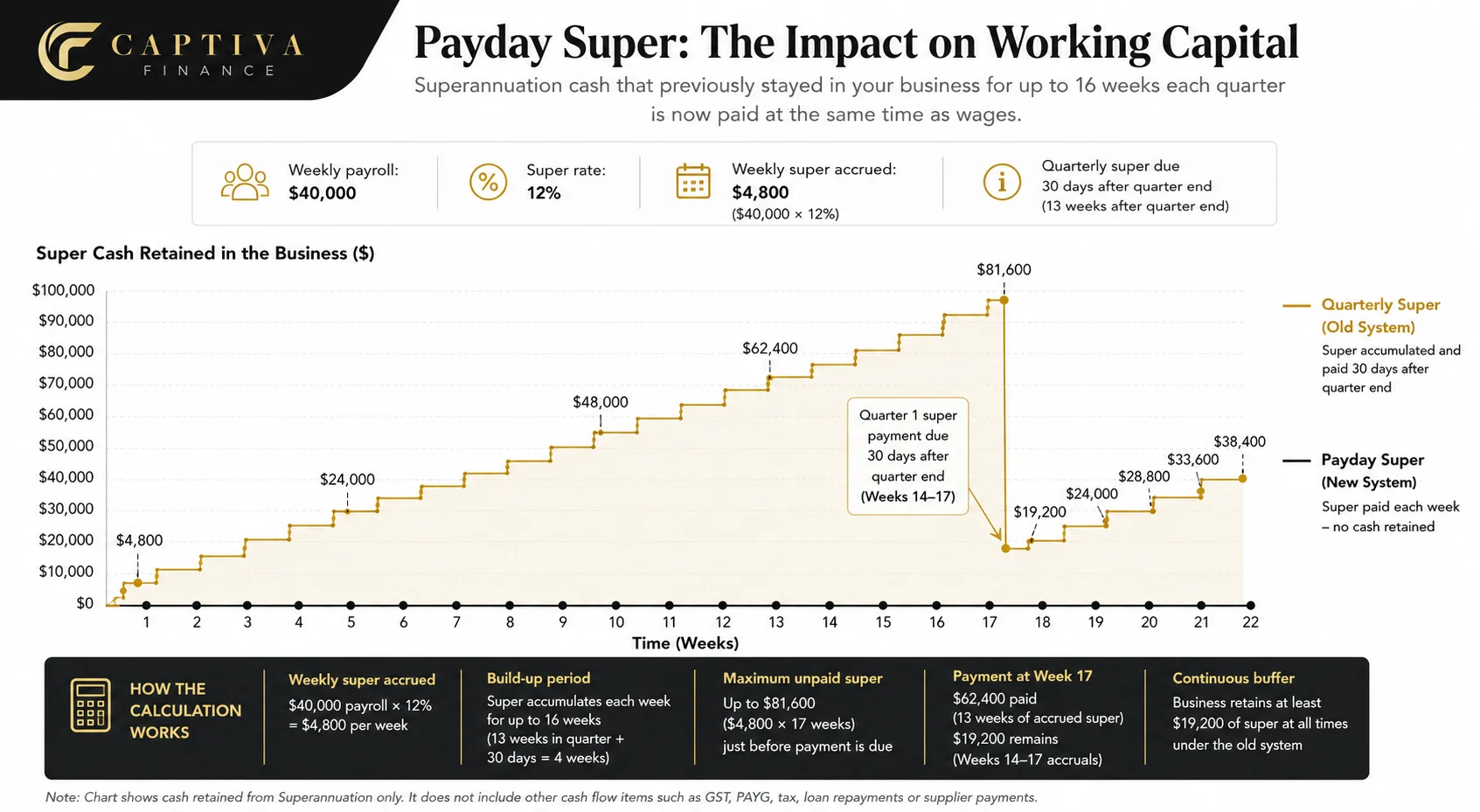
If your annual payroll is $2 million, your total superannuation expense remains the same. The difference is that those contributions now leave your bank account throughout the year instead of accumulating until quarterly payment dates.
For businesses that have traditionally retained those funds to assist with working capital, this can have a noticeable impact.
Consider a business with:
- Weekly payroll of $40,000.
- Super contributions of approximately $4,800 per week.
Under the previous system, those contributions may have remained within the business for several weeks before payment was due. Today, those funds leave the business much sooner.
While that money was never truly available to spend, many businesses benefited from the additional liquidity. Removing that timing difference means cash flow planning becomes even more important.
Businesses with larger payrolls or relatively small cash reserves are likely to notice the greatest change.
Why Working Capital Is More Important Than Ever
This time of year already places pressure on many businesses.
Following the end of the financial year, it’s common to see several significant financial obligations falling due within a relatively short period, including:
- BAS liabilities
- PAYG instalments
- Income tax payments
- Accounting and compliance costs
- Ongoing payroll commitments
- Supplier payments
- Business loan repayments
With superannuation now flowing out of the business much more regularly, there is less opportunity to rely on payment timing to smooth cash flow.
The reality is that many profitable businesses still experience cash flow pressure. Profit and cash flow are not the same thing.
Businesses can be growing strongly, employing more staff and generating healthy profits, yet still experience periods where cash becomes tight simply because money is leaving the business faster than it is coming in.
That’s why working capital management becomes increasingly important under Payday Super.
Which Businesses Are Most Likely to Feel the Impact?
Every employer will need to adjust to the new payment timing, but some industries are likely to notice the impact more than others.
Businesses where wages make up a significant proportion of operating costs include:
- Construction and trades
- Hospitality
- Manufacturing
- Transport and logistics
- Labour hire
- Healthcare
- Professional services
The larger the payroll, the greater the amount of cash that now leaves the business throughout the year rather than accumulating until quarterly payment dates.
Practical Steps You Can Take
The transition to Payday Super doesn’t need to create unnecessary stress. Like most cash flow challenges, good planning generally creates more options.
Review Your Cash Flow Forecast
If you don’t already prepare regular cash flow forecasts, now is the time to start.
Looking ahead 8 to 12 weeks allows you to identify periods where cash may become tight before they become a problem.
It also provides time to make informed decisions rather than reacting under pressure.
Treat Super as Money That Never Belongs to the Business
One of the simplest adjustments is changing how you think about superannuation.
Rather than viewing quarterly payment dates as additional flexibility, treat super as money that belongs to your employees from the moment payroll is processed.
That mindset helps build stronger financial discipline and makes the new payment timing much easier to manage.
Improve Debtor Collection
If your business invoices customers, improving debtor collection can often unlock cash without borrowing additional funds.
Simple improvements such as:
- Issuing invoices promptly
- Following up overdue accounts earlier
- Monitoring outstanding debtors regularly
- Making payment easier for customers
can significantly improve working capital over time.
Review Supplier Terms
Don’t overlook the other side of the cash flow equation.
Reviewing supplier payment terms, purchasing cycles or stock management may provide additional flexibility without affecting day-to-day operations.
These discussions are generally easier to have before cash flow becomes tight.
Review Your Funding Arrangements
Many businesses already have access to funding facilities that may no longer suit how the business operates today.
Depending on your circumstances, it may be appropriate to review options such as:
- Business overdrafts
- Lines of credit
- Working capital facilities
- Debtor finance
- Trade finance
Importantly, these facilities should support normal business operations and future growth—not simply fund ongoing cash shortages.
Having appropriate funding in place before it’s needed generally provides greater flexibility and stronger negotiating power.
Review Pricing and Margins
Many businesses have absorbed increasing employment costs, insurance premiums and supplier price rises over recent years.
Payday Super provides a timely reminder to review whether your pricing still reflects the true cost of delivering your products or services.
Even relatively small improvements in gross margin can have a meaningful impact on long-term cash flow.
Work With Your Accountant
Your accountant plays an important role in forecasting tax liabilities and helping you plan for significant payments throughout the year.
Understanding upcoming obligations well before they fall due allows better planning and reduces the likelihood of unexpected cash flow pressure.
Good Businesses Will Adapt
The reality is that well-managed businesses already focus on forecasting, working capital and cash flow discipline.
Payday Super doesn’t fundamentally change those principles—it simply brings the timing of one expense forward.
Businesses that already understand their cash conversion cycle and actively manage working capital are unlikely to experience significant disruption.
For others, the change may simply highlight opportunities to strengthen existing financial processes.
When Should You Review Your Funding?
If your business regularly experiences cash flow pressure, now is an ideal time to review your funding arrangements.
Some common warning signs include:
- Regularly relying on ATO payment plans
- Delaying supplier payments to preserve cash
- Frequently reaching overdraft limits
- Using personal funds to support business operations
- Relying on credit cards for business expenses
- Feeling pressure every payroll cycle
None of these necessarily indicate that a business is performing poorly.
More often, they suggest that the business has outgrown its current funding structure or that working capital could be managed more effectively.
Addressing these issues early generally provides more options than waiting until cash flow becomes critical.
How Captiva Finance Can Help
Every business operates differently.
Some businesses experience predictable seasonal fluctuations. Others are growing rapidly, taking on larger contracts or employing more staff. Each situation requires a funding strategy that reflects how the business actually operates.
At Captiva Finance, we help business owners understand their cash flow requirements and structure finance that supports sustainable growth.
That may involve reviewing existing lending, assessing whether a working capital facility is appropriate or identifying funding solutions that provide greater flexibility as cash flow needs change.
With access to more than 40 lenders, we work alongside your accountant and other professional advisers to help ensure your finance structure supports your broader business objectives.
Final Thoughts
Payday Super isn’t something to fear, but it is something to plan for.
For many businesses, the change will simply require a small adjustment to how cash flow is managed. For others, it may highlight the need for stronger forecasting or a more appropriate working capital facility.
The businesses that prepare early generally have the greatest number of options available to them.
If you’re unsure how Payday Super may affect your business, or you’d like to review whether your current funding arrangements are still appropriate, we’d be happy to have a conversation.